


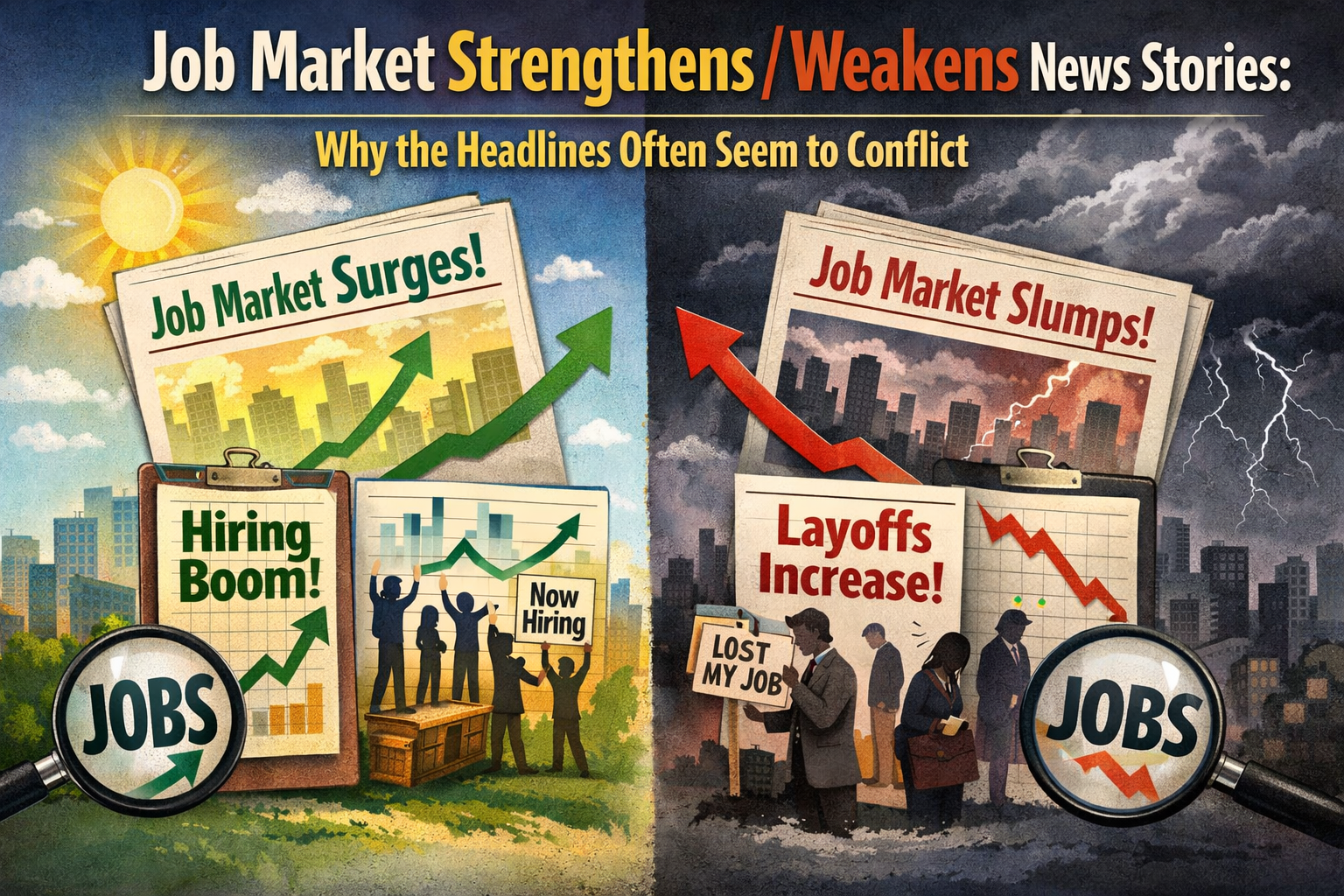
If you keep seeing job market strengthens/weakens news stories, you are probably noticing something real. One headline says the labor market is holding up well. Another says hiring is cooling and cracks are starting to show. At first glance, those stories seem to contradict each other. In reality, they often describe different parts of the same economy.
That is especially true right now. In the latest official U.S. jobs report, nonfarm payrolls rose by 178,000 in March 2026 and the unemployment rate was 4.3%, which gives writers plenty of reason to describe the labor market as resilient. At the same time, the same report also showed payroll employment had changed little on net over the prior 12 months, while labor-force participation stayed at 61.9% and long-term unemployment remained elevated at 1.8 million. That gives other writers a strong basis for more cautious or weaker-sounding coverage.
So the real story is not that one side is lying and the other is telling the truth. It is that the job market can be steady in one area and softer in another at the exact same time.
Why Job Headlines Can Sound So Different
The biggest reason job market strengthens/weakens news stories feel inconsistent is that labor-market reporting is built from several different indicators, not one simple score. A reporter looking at payroll growth may write a stronger headline. A reporter focused on hiring rates, labor-force participation, or long-term unemployment may write a weaker one.
Take the March 2026 employment report as an example. Payrolls increased by 178,000, and job gains showed up in health care, construction, and transportation and warehousing. On its face, that sounds healthy enough for a “job market strengthens” story. But the same release also noted that federal government employment continued to decline, that employment had changed little on net over the prior 12 months, and that the number of long-term unemployed was up 322,000 over the year.
That is why two different headlines can both be fair. One highlights momentum. The other highlights fragility.
The Stronger Side of the Story
There are solid reasons some recent coverage leans positive. The most obvious one is that jobs are still being added. The March report showed 178,000 new payroll jobs, which followed a weak February and suggested that hiring did not completely stall. Health care alone added 76,000 jobs, while construction added 26,000 and transportation and warehousing added 21,000.
Layoffs also remain relatively contained by historical standards. In the latest weekly claims data, the advance figure for seasonally adjusted initial jobless claims was 207,000 for the week ending April 11, 2026, down from 218,000 the week before. The four-week moving average was 209,750. That kind of number does not usually signal a labor market in sudden collapse.
Wages are still rising too. In March, average hourly earnings for all employees on private nonfarm payrolls rose by 0.2% for the month and 3.5% over the year, reaching $37.38. Wage growth is not exploding, but it is still moving upward, which supports the view that employers continue to compete for workers in many areas.
When news outlets emphasize those points, the “strengthens” angle makes sense.
The Weaker Side of the Story
At the same time, there are equally valid reasons for softer headlines. Job growth is continuing, but it is not broad, fast, or obviously booming. The March report itself said payroll employment had changed little on net over the prior 12 months, which is not the language of an overheated labor market.
The same report also showed signs of under-the-surface softness. The labor force participation rate stayed at 61.9%, the employment-population ratio stayed at 59.2%, and the number of people marginally attached to the labor force rose to 1.9 million. Within that group, discouraged workers increased to 510,000. Those figures matter because they suggest some people want work but are not fully engaged in the labor market.
Long-term unemployment is another reason some stories sound weaker. In March, the number of people unemployed for 27 weeks or more was 1.8 million, up 322,000 over the year. Even if the top-line unemployment rate looks manageable, a rise in long-term unemployment tells a more difficult story for people who have been stuck outside the job market for months.
So when journalists focus on these signals, “weakens” is not a stretch either.
Why Hiring and Firing Can Both Look Slow
One of the most useful ways to understand modern labor coverage is to realize the U.S. job market is often neither booming nor crashing. Instead, it can sit in a low-hiring, low-firing phase where employers are cautious but not panicking.
The latest Job Openings and Labor Turnover Survey supports that reading. In February 2026, job openings were 6.9 million, hires were little changed at 5.0 million, and total separations were also little changed at 5.4 million. Within separations, quits were 3.0 million and layoffs and discharges were 1.7 million, both essentially unchanged.
That combination can create confusing headlines. Openings are still substantial, which sounds good. But hiring is not exactly surging, and workers are not quitting at especially aggressive levels either. This is one reason labor-market stories now often sound more mixed than they did in the immediate post-pandemic rebound. The market may still function, but it is not moving with the same confidence.
Why One Month of Data Can Change the Tone
Another reason job market strengthens/weakens news stories shift so quickly is that the narrative can change from month to month. February looked weak in the payroll data, but March rebounded. The March report noted that payroll employment rose 178,000 after a February decline of 133,000. That alone can swing media language from concern to relief.
Revisions also shape the tone. The same BLS report said January was revised up by 34,000, while February was revised down by 41,000, leaving combined revisions only 7,000 lower than previously reported. A writer emphasizing the rebound may sound optimistic. A writer emphasizing that the pattern still looks uneven may sound cautious. Both are working from the same document.
That is why labor stories often feel emotional even when they are data-driven. They are responding not just to the level of the numbers, but to the direction and momentum.
What the Federal Reserve’s Business Contacts Are Seeing
Official surveys are not the only thing shaping coverage. The Federal Reserve’s April 2026 Beige Book offers a more qualitative look at the economy, and it also helps explain why labor headlines are mixed.
The Fed said overall economic activity increased at a slight to modest pace in eight of the twelve districts, while two districts reported little change and two reported slight to modest declines. It also said the conflict in the Middle East had become a major source of uncertainty, complicating decisions around hiring, pricing, and capital investment, and pushing many firms into a wait-and-see posture. At the same time, wage growth was described as modest to moderate, with stronger wage pressure mainly in specific roles such as health care and the skilled trades.
That kind of language naturally leads to softer stories. Businesses are not saying the floor is falling out, but they are clearly not talking like companies ready to hire aggressively either. When uncertainty rises, hiring often slows before layoffs meaningfully increase. That creates exactly the kind of gray zone that produces conflicting headlines.
What Readers Should Pay Attention To
If you want to make sense of job market strengthens/weakens news stories, it helps to look past the headline and ask a few simple questions. Is the story talking about payroll gains, layoffs, hiring, wages, or participation? Is it describing one month, the past year, or a new trend in business confidence? Is it focused on the national picture or one sector like health care, construction, or government?
Right now, the labor market looks more mixed than extreme. Payroll growth in March was respectable, layoffs remain fairly low, and wages are still rising. But hiring is not especially hot, participation is not climbing, long-term unemployment is higher than a year ago, and many businesses are behaving cautiously.
That means readers should be careful with absolute language. “Strengthens” and “weakens” are often headline shortcuts for a labor market that is doing both, depending on where you look.
Why This Keyword Matters
The phrase job market strengthens/weakens news stories matters because it reflects a real frustration people have with economic coverage. Workers, employers, investors, and voters all want a clear answer about whether the economy is getting better or worse. But the labor market rarely moves in one clean direction.
At the moment, the most accurate description is probably that the job market is still functioning, but with less confidence than a truly strong labor market would show. Jobs are being added, yet caution is widespread. Layoffs are low, yet hiring is not especially energetic. Wages are growing, yet more people are stuck in long-term unemployment or sitting on the edge of the labor force.
That is not a contradiction. It is just what a late-cycle, uncertainty-heavy labor market often looks like.
FAQs
Why do job market news stories say both strengthens and weakens?
Because they often focus on different indicators. Some stories emphasize payroll growth, falling jobless claims, or wage gains, while others focus on weak hiring momentum, low participation, or rising long-term unemployment.
Did the U.S. job market strengthen in March 2026?
In some ways, yes. The U.S. added 178,000 payroll jobs in March 2026, and the unemployment rate was 4.3%. Those numbers support a relatively resilient reading.
What signs suggest the job market may be weakening?
Payroll growth has been modest over the past year, the labor-force participation rate was only 61.9% in March, long-term unemployment was 1.8 million, and the number of marginally attached workers rose to 1.9 million.
Are layoffs rising sharply right now?
Not based on the latest claims data. Initial jobless claims were 207,000 for the week ending April 11, 2026, which is still a relatively low level historically.
What does JOLTS say about the labor market?
The latest JOLTS report showed 6.9 million job openings in February 2026, with hires at 5.0 million, quits at 3.0 million, and layoffs and discharges at 1.7 million. That points to a labor market that is still active, but not especially hot.
Why do businesses sound cautious even when unemployment is low?
The Federal Reserve’s April 2026 Beige Book said many firms had moved into a wait-and-see posture because of uncertainty, including the conflict in the Middle East and its effects on hiring, pricing, and investment decisions.
What is the best way to read job market headlines?
Look beyond the headline and check which metric the story is using. Payrolls, unemployment, hiring, layoffs, participation, and wages can all point in slightly different directions at the same time.
