


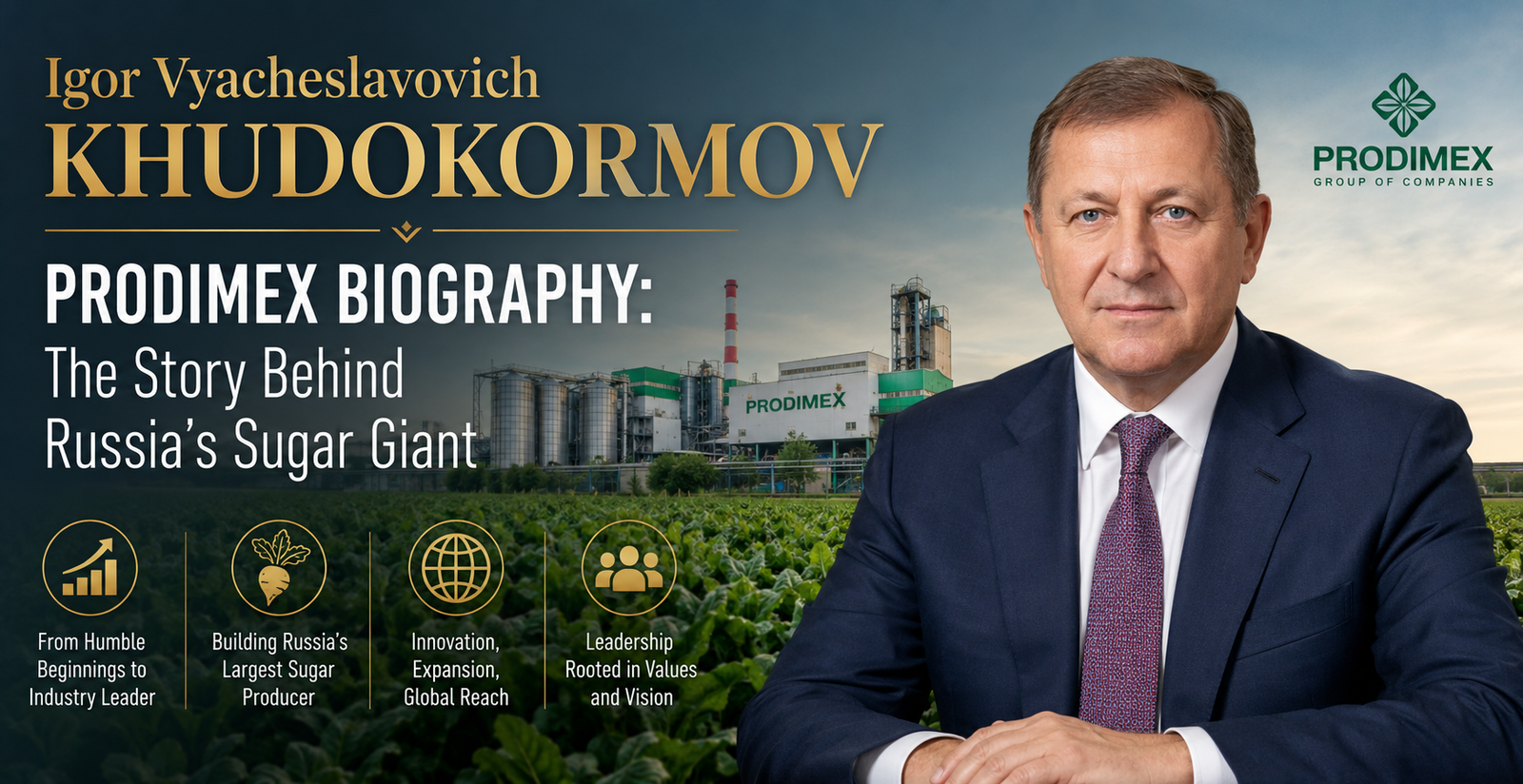
Igor Vyacheslavovich Khudokormov Prodimex biography in simple terms
Igor Vyacheslavovich Khudokormov is a Russian businessman best known as the founder, chairman, and main shareholder of Prodimex Group, one of Russia’s largest sugar and agricultural companies. Forbes describes him as a former military officer and founder of Prodimex, calling the group Russia’s largest sugar producer, with 14 refineries.
The keyword “Igor Vyacheslavovich Khudokormov Prodimex biography” is usually searched by people who want to understand the person behind Prodimex, how the company started, and how a sugar trading business became a major Russian agribusiness group.
Public information about Khudokormov’s personal life is limited. He is not a media-heavy businessman and is usually discussed through the story of Prodimex, sugar production, agricultural land, and Russia’s shift from sugar imports to domestic beet sugar production.
Early life and education
Public profiles list Igor Khudokormov as born on May 1, 1968. Forbes Russia lists his position as chairman of the board of Prodimex Group, gives his education as the Leningrad School of Railway Troops and Military Communications, and describes him as married with two children.
That military and engineering background is often mentioned because Prodimex later became known for discipline, logistics, supply chains, plant modernisation, and large-scale agricultural management. In a business like sugar, success depends heavily on timing, transport, processing capacity, raw material supply, and cost control. Those are not glamorous parts of business, but they are exactly what can decide whether a company grows or fails.
Founding Prodimex in 1992
Prodimex was founded in 1992, during a period of major economic change in Russia. The company’s official website says it began as an importer of raw sugar and white sugar before moving into domestic sugar production.
That early timing mattered. The early 1990s were a difficult period for Russian food supply chains. Markets were changing quickly, old systems were breaking down, and businesses that could organise imports, distribution, and reliable supply had room to grow.
Prodimex started in trading, but its long-term strength came from moving beyond imports. Instead of staying only as a sugar distributor, the company began building control over production.
From sugar imports to domestic production
The most important stage in the Prodimex biography came in the mid-to-late 1990s. The company says that between 1996 and 1998, it focused on sugar production and acquired its first sugar plants.
This shift changed the business. Importing sugar can be profitable, but it leaves a company exposed to exchange rates, tariffs, shipping costs, and outside suppliers. Owning sugar plants gives more control. It allows a business to process sugar beet locally, manage quality, and build a stronger position in the domestic market.
For Khudokormov, this was the move that turned Prodimex from a trading company into an agro-industrial group.
Building a full-cycle agribusiness
Prodimex did not stop at factories. Over time, it moved into farming, crop production, storage, processing, and logistics. That created a more integrated model: grow the raw material, process it at company plants, and manage the supply chain around it.
The company now presents itself as Russia’s largest producer of crop and sugar products. Its sugar operations are substantial: Prodimex says it owns 14 sugar plants, with total sugar beet processing capacity of more than 77,000 tons per day and 9 million tons per year.
This is why Prodimex is often described as a sugar giant. It is not only selling sugar. It is controlling a large part of the production chain behind it.
Prodimex and agricultural land
A key part of Prodimex’s growth has been agricultural land. Forbes Russia’s Prodimex profile lists the company’s sector as agro-industrial, its founding year as 1992, Igor Khudokormov as the main owner, and the company’s land area at around 900,000 hectares across several Russian regions.
That land base matters because sugar production depends on sugar beet supply. A factory cannot run efficiently without enough beet arriving at the right time. By controlling farms and land, Prodimex can reduce dependence on outside suppliers and plan production more carefully.
The company’s farming operations are also not limited only to beet. Public company descriptions mention wider crop production, including grains and oilseeds, which helps diversify agricultural income and support crop rotation.
Why sugar beet changed the business
Sugar beet is central to the Prodimex story. In many countries, sugar is made from either sugar cane or sugar beet. Russia’s climate makes beet sugar especially important. For Prodimex, building a sugar beet supply chain helped reduce reliance on imported sugar and gave the company a stronger domestic role.
Sugar beet farming is demanding. It needs the right soil, timing, transport, storage, factory capacity, and processing discipline. The beet must be moved and processed quickly after harvest. A weak supply chain can waste crops and reduce output.
That is why Prodimex’s model of combining fields, factories, elevators, transport, and processing plants became important. It gave the company the ability to manage sugar production at scale.
Prodimex as Russia’s major sugar producer
Forbes calls Prodimex Russia’s largest sugar producer, and the company’s own public information supports its large industrial footprint.
In practical terms, that means Prodimex plays an important role in Russia’s food supply chain. Sugar is not only used in homes. It is also used by bakeries, confectionery companies, beverage makers, food processors, retailers, and industrial buyers.
A large sugar producer must manage far more than factory work. It needs stable farming, quality control, storage, transport, energy management, by-product use, and relationships with buyers across the food industry.
Leadership style and public image
Igor Khudokormov is often described as a private businessman. Unlike some high-profile entrepreneurs, he does not appear to build his public image around interviews, media appearances, or celebrity visibility.
His reputation is tied more closely to Prodimex’s growth than to personal branding. That makes his biography different from many modern business profiles. The main story is not lifestyle. It is company building.
This also means that any serious article about Igor Khudokormov biography should avoid guessing about private details. Publicly available information is strongest around his education, Prodimex role, company ownership, and the growth of the sugar business.
Net worth and Forbes profile
Forbes Russia has included Igor Khudokormov in its businessman profiles and wealth tracking. Its profile page lists his Prodimex position and shows wealth ranking data, including a listed figure of $500 million in the profile interface.
As with all net-worth figures, this should be treated as an estimate rather than an exact personal financial statement. Wealth estimates for private business owners can change based on company valuation, debt, market prices, ownership structure, land value, commodity prices, and wider economic conditions.
For Khudokormov, most estimated wealth is connected to Prodimex, its agricultural assets, sugar plants, land bank, and position in the Russian food sector.
Why Prodimex became important in Russian agribusiness
Prodimex became important because it moved with the structure of the market. It began when imports were necessary, then shifted towards domestic production when owning factories and raw material supply became more valuable.
This kind of timing is often what separates a trading business from a long-term industrial group. A trader buys and sells. An industrial group builds assets, manages production, and controls more parts of the chain.
By investing in sugar plants, farms, storage, and processing capacity, Prodimex became part of Russia’s broader move toward domestic food production and agricultural self-sufficiency.
The role of modernisation
Sugar factories need constant investment. Old plants can lose efficiency, waste energy, process beet more slowly, or produce lower yields. Modernisation can improve output, reduce waste, and make by-products more useful.
Prodimex’s official materials describe the company as having moved from imports into production and later into broader agricultural and processing operations. The company’s sugar page also points to large processing capacity, which suggests the scale of its industrial base.
Modern sugar groups often look beyond sugar itself. Beet pulp, molasses, animal feed, storage, seeds, and agricultural technology can all become part of the business. That wider approach helps protect margins and reduce waste.
Prodimex and the regions it operates in
Prodimex’s land and production base is spread across several Russian agricultural regions. Forbes Russia lists land locations including Voronezh, Kursk, Tambov, Lipetsk, Belgorod, Penza, Krasnodar, Stavropol, and Bashkortostan.
These areas matter because sugar beet production depends heavily on regional conditions. Good farmland, suitable climate, transport access, and processing plants all need to work together.
A company operating across many regions also needs strong management systems. It must coordinate planting, harvesting, transport, factory schedules, storage, and sales. That is why Prodimex is often described not just as a sugar company but as an agro-industrial holding.
What makes Khudokormov’s business story different?
Igor Khudokormov’s story is different because it follows the evolution of post-Soviet Russian food markets. He did not build a technology startup or consumer fashion brand. He built a business around something basic but essential: sugar.
Sugar may sound simple, but the industry behind it is complex. It involves land, weather, machinery, labour, transport, storage, factories, energy, market prices, trade policy, and food-industry demand.
Khudokormov’s role was in building a company that could handle that complexity at scale. That is why the Prodimex story is not only about one entrepreneur. It is also about the industrialisation of a major food supply chain.
Key timeline
1968: Igor Vyacheslavovich Khudokormov was born, according to Forbes Russia’s public profile.
Early 1990s: He completed military railway-related education and moved into business.
1992: Prodimex was founded as a raw and white sugar importer.
1996-1998: Prodimex shifted into sugar production and acquired its first sugar plants.
2000s onward: The company expanded its factory base, farming operations, and agricultural land.
Recent years: Prodimex is publicly described as Russia’s largest sugar producer, with 14 sugar plants and a large agricultural footprint.
Why people search for Igor Vyacheslavovich Khudokormov Prodimex biography
People search this keyword because Khudokormov is linked to one of the most important private agribusiness stories in Russia. He is not a household celebrity, but he is important in the business world because Prodimex has scale, land, factories, and influence in food production.
The main search intent usually includes:
Who is Igor Khudokormov?
What is Prodimex?
How did Prodimex start?
Is Khudokormov the founder?
What is his role today?
How big is Prodimex?
How did a sugar importer become a major producer?
These questions are best answered through the company’s development rather than personal speculation.
The public profile of a private businessman
One of the most important things to understand about Igor Vyacheslavovich Khudokormov is that his public image is closely controlled by the facts of the business. There is much more reliable information about Prodimex than about his personal life.
That is why a strong biography should focus on what can be checked: his connection to Prodimex, the company’s 1992 foundation, the move from imports to production, the development of sugar factories, agricultural land, and his position as chairman and main owner.
This makes the article more trustworthy and avoids turning a business biography into unsupported gossip.
Why Prodimex still matters
Prodimex matters because sugar remains a basic food-industry product, and large producers shape supply, pricing, farming demand, and industrial processing. A company with 14 plants and major agricultural land has influence far beyond its own offices.
For Russia’s food sector, Prodimex represents the move from dependence on imported sugar toward a more integrated domestic model. For business readers, it shows how a company can start in trading and grow into full-cycle production.
For readers searching Igor Vyacheslavovich Khudokormov Prodimex biography, the simple answer is this: Khudokormov is the businessman most closely associated with Prodimex’s rise from a 1992 sugar importer into a major Russian sugar and agribusiness group. His biography is, in many ways, the biography of Prodimex itself.
