


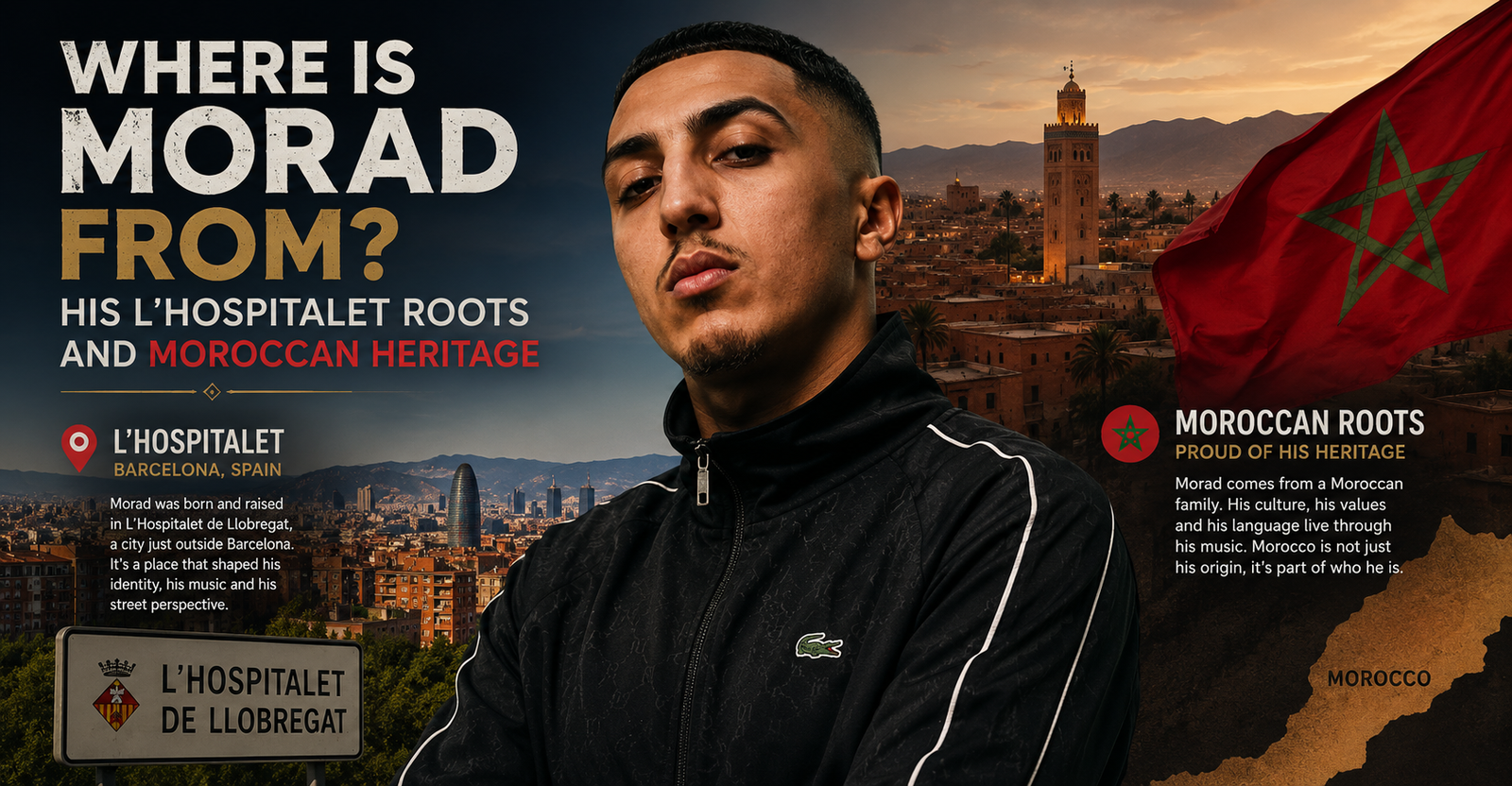
Where is Morad from?
Morad is from L’Hospitalet de Llobregat, a city next to Barcelona in Catalonia, Spain. More specifically, he is strongly linked with La Florida, a working-class neighbourhood in L’Hospitalet that has become a central part of his public image and music identity. His full name is Morad El Khattouti El Horami, and public profiles describe him as a Moroccan-Spanish rapper and singer born on 5 March 1999.
That is the simple answer, but it does not tell the whole story. Morad’s background is both local and cultural: he was born in Spain, raised in the Barcelona-area streets he often references, and comes from a Moroccan family. His mother is reported to be from Larache, while his father was from Nador in Morocco.
So when people ask “where is Morad from?”, the most accurate answer is: Morad is from La Florida in L’Hospitalet de Llobregat, Spain, and has Moroccan heritage through his parents.
Morad’s birthplace: L’Hospitalet de Llobregat
L’Hospitalet de Llobregat is often shortened to L’Hospitalet. It sits directly beside Barcelona and is one of the most densely populated cities in Spain. For many outsiders, Barcelona is the name they recognise first, but for Morad’s identity, L’Hospitalet matters more.
Morad is not simply “a rapper from Barcelona.” He is closely tied to La Florida, the neighbourhood where his early story, street references, friendships, and music identity took shape. Public biographies consistently connect his early life to La Florida and L’Hospitalet rather than central Barcelona.
That detail matters because urban music is often rooted in place. The streets, apartment blocks, local parks, shops, police encounters, friendships, and daily pressures of a neighbourhood can shape a rapper’s voice. Morad’s music feels tied to that kind of lived environment.
Why La Florida is important to Morad’s story
La Florida is more than a location in Morad’s biography. It is part of his artistic identity. His lyrics often carry the feeling of the neighbourhood: loyalty, struggle, street life, exclusion, ambition, survival, and the desire to rise without forgetting where he came from.
Morad’s public image is built around being real to his area. He does not present himself as someone polished by the industry from the start. He presents himself as someone who came from a tough background and turned that into music.
That is why fans connect the phrase Morad La Florida with his name. The neighbourhood gives context to his sound, his slang, his visuals, and the strong sense of community that runs through much of his work.
Is Morad Spanish or Moroccan?
Morad is best described as Moroccan-Spanish. He was born in Spain and built his music career there, but his family background is Moroccan. Public profiles describe him as a Moroccan-Spanish rapper, and his early life is connected to Moroccan parents from Larache and Nador.
This kind of identity is common among many young people in Spain with North African family roots. Nationality, culture, language, neighbourhood, and family history can all exist together. Morad’s case is not a simple choice between Spanish or Moroccan. His story sits between both worlds.
That mix is part of why his music connects with listeners across Spain, Morocco, France, and other places where young people understand immigrant-family identity, class pressure, and the feeling of being judged by society.
Morad’s Moroccan heritage
Morad’s Moroccan heritage is a major part of his background. His mother is reported to be from Larache, a port city in northern Morocco, while his father was from Nador, another northern Moroccan city with strong cultural ties to migration and Europe.
This heritage appears in how people discuss his music, image, and audience. Morad belongs to the Spanish urban music scene, but he also reflects the wider Maghrebi diaspora experience in Europe. His style has often been connected with French rap, drill, and street music associated with young artists of North African origin.
That background helps explain why his audience is not limited to Spain. His music speaks to people who recognise the same cultural tension: being born or raised in Europe while carrying family roots from Morocco or elsewhere in North Africa.
How his background shaped his music
Morad’s music often sounds personal because it comes from a clear place and experience. Public summaries of his artistry describe his lyrics as being inspired by childhood and teenage experiences, including difficult circumstances, marginalisation, and street life.
That does not mean every lyric should be read as literal autobiography. Like any rapper, Morad uses storytelling, attitude, rhythm, exaggeration, and street language. But his music clearly draws energy from his environment.
Themes that often fit his work include:
Neighbourhood loyalty
Street pressure
Police tension
Racism and exclusion
Friendship and betrayal
Ambition and survival
Moroccan-Spanish identity
Respect and reputation
This is why the question “where is Morad from?” is not just about geography. His place of origin explains a lot about the emotional tone of his music.
What does MDLR mean?
One of the most important terms connected to Morad is MDLR. The abbreviation comes from the French phrase “Mec de la Rue,” meaning “street boy” or “guy from the street.” Morad helped popularise this phrase in Spain, and his debut album was titled M.D.L.R.
MDLR fits his identity because it connects his music to street life, neighbourhood culture, and the influence of French and Maghrebi rap. It is not just a slogan. It became part of his brand and a way for fans to understand the world he represents.
For many listeners, MDLR is connected with authenticity. It suggests someone who comes from outside elite spaces and speaks for people who often feel ignored.
Morad’s early music journey
Morad began rapping as a teenager. Public profiles say he started rapping with friends at around 14, using WhatsApp as part of that early creative process. He later began releasing music more seriously and became active professionally around 2019.
His early rise was shaped by online platforms, music videos, street support, and word of mouth. This matters because Morad did not build his career through traditional radio first. His audience grew because people shared his songs, connected with his image, and felt that he represented something real.
That grassroots rise helped him build a loyal fanbase before wider mainstream attention fully arrived.
From local rapper to Spanish urban star
Morad’s career grew quickly after his early releases. He released M.D.L.R in 2019 and later became one of the most visible names in Spanish drill and urban music. His collaboration with Argentine producer Bizarrap on Bzrp Music Sessions Vol. 47 topped the Spanish singles chart, and his song Pelele also reached number one in Spain.
Those songs helped move him from local credibility to wider recognition. They also showed that his sound could travel beyond L’Hospitalet without losing its street identity.
For many fans, that is part of his appeal. He became famous, but his brand still points back to La Florida, tracksuits, street language, and neighbourhood pride.
Morad and Spanish drill
Morad is often linked with Spanish drill, hip-hop, trap, and urban music. His style has similarities with French rap and drill music shaped by artists of Maghrebi background. Public profiles list his genres as hip-hop, drill, and afrobeats, showing that his sound is not limited to one lane.
Spanish drill grew by mixing local street stories with influences from the UK, France, North Africa, and Latin urban music. Morad became one of the best-known voices in that space because he sounded direct, raw, and believable.
His songs often have a quick, conversational delivery. The tone can feel tense, proud, defensive, or reflective, depending on the track. That makes his music work both as street rap and as personal storytelling.
Why fans ask where Morad is from
Fans ask “where is Morad from?” for a few reasons. Some hear his Spanish lyrics and want to know if he is from Spain. Others hear his name, cultural references, or Moroccan identity and wonder about his roots. Some know him through Barcelona-area urban music but want to understand why La Florida appears so often around his image.
The curiosity is natural because Morad’s background is part of his music. His identity is not hidden. It is part of the sound, visuals, and message.
A simple answer gives the facts. A better answer explains the layers: born in L’Hospitalet, raised around La Florida, Moroccan family roots, Spanish urban music career, and a strong connection to neighbourhood life.
Morad’s image and tracksuit style
Morad is also known for his tracksuit image. Public profiles note that he has frequently worn tracksuits in music videos and concerts, and the style became part of how people recognise him.
This fits the MDLR identity. The tracksuit is not just fashion. In his case, it works as a visual symbol of street culture, comfort, youth identity, and refusal to dress for elite approval.
Morad has even spoken about how people treated him differently before fame because of how he dressed, while later the same image became part of his stage presence. That kind of reversal is common in street culture: what society once looks down on can later become style, brand, and identity.
Morad’s connection to football and La Florida
Morad’s local identity has also connected with football. Public reports note that he collaborated with Adidas and later had a relationship with clothing connected to La Florida FC, a football club in the area where he grew up.
That detail matters because football is often part of neighbourhood culture in Spain. It gives young people a common language, a sense of belonging, and a way to represent the area. For Morad, supporting local identity through music and clothing helps keep his roots visible even as his fame grows.
Common questions about Morad’s background
Where was Morad born?
Morad was born in L’Hospitalet de Llobregat, Catalonia, Spain.
What neighbourhood is Morad from?
He is strongly associated with La Florida, a neighbourhood in L’Hospitalet de Llobregat.
Is Morad Moroccan?
Morad has Moroccan heritage through his parents. Public profiles describe him as Moroccan-Spanish.
Where are Morad’s parents from?
His mother is reported to be from Larache, and his father was from Nador, both in Morocco.
What does MDLR mean?
MDLR comes from “Mec de la Rue,” a French phrase meaning street boy or guy from the street.
The simple answer
Morad is from La Florida in L’Hospitalet de Llobregat, near Barcelona, Spain. He was born in Spain and comes from a Moroccan family, with roots linked to Larache and Nador. His background is often described as Moroccan-Spanish, and that mix of L’Hospitalet street life and Moroccan heritage is central to his identity as an artist.
For fans searching “where is Morad from,” the place name matters because it explains the music. L’Hospitalet gave him the streets, La Florida gave him the neighbourhood identity, and his Moroccan roots gave him a cultural background that connects with many listeners across Europe and North Africa.
