


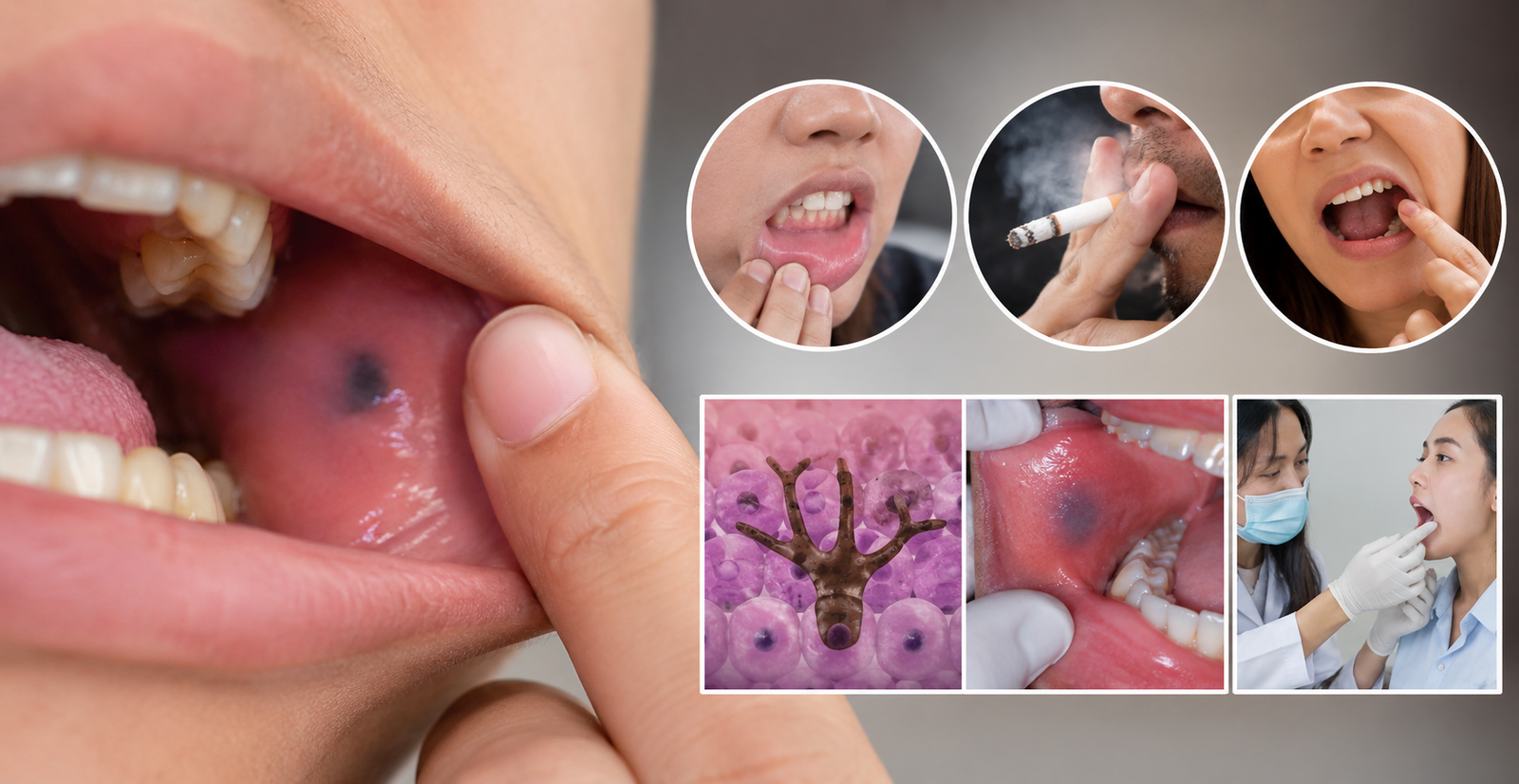
Finding a black spot inside cheek can feel worrying, especially when it appears suddenly or you do not remember biting the area. A black spot on inner cheek, black dot in cheek, or dark spot inside cheek of mouth can come from something simple like cheek biting, a blood blister, dental work, or harmless pigmentation. In rare cases, a dark mouth spot can also need medical or dental evaluation.
The inside of the cheek is called the buccal mucosa. It is soft, delicate tissue, so even small trauma, irritation, or pigment changes can look more noticeable than they would on normal skin.
Quick Answer: What Does a Black Spot Inside the Cheek Mean?
A black mark on inside of cheek is not always dangerous. Many dark mouth spots are harmless, especially if they are small, flat, painless, and linked to an obvious cause like cheek biting or dental fillings.
Common causes include:
Blood blister from cheek biting
Bruise or small hematoma
Melanotic macule
Amalgam tattoo from dental filling material
Smoker’s melanosis
Medication-related pigmentation
Oral melanoacanthoma
Natural melanin pigmentation
Rarely, oral melanoma or another serious lesion
A spot that is new, growing, irregular, painful, bleeding, ulcerated, or not going away should be checked by a dentist, oral surgeon, or doctor.
A Blood Blister or Cheek Bite
One of the simplest causes of a black dot in cheek is trauma. You may accidentally bite the inside of your cheek while eating, sleeping, talking, or chewing. Hot food, sharp chips, braces, dentures, broken teeth, or rough dental edges can also irritate the area.
A blood blister can look dark red, purple, brown, or black. It may feel raised, sore, or tender. If it came from trauma, it often improves as the tissue heals.
You may notice:
A sudden dark spot after eating
Tenderness when chewing
A small raised bubble
A purple-black color
Improvement within days
Do not pop a blood blister inside the mouth. Keep the area clean, avoid spicy or sharp foods for a few days, and see a dentist if it keeps coming back in the same place.
Melanotic Macule: A Common Benign Pigmented Spot
A melanotic macule is a small, flat, harmless pigmented spot caused by extra melanin in the mouth lining. It may appear brown, dark brown, blue-black, or almost black depending on pigment depth and lighting.
DermNet describes melanotic macules as harmless pigmented lesions, and notes that similar lesions can appear in areas that are not sun-exposed, including inside the mouth. Colgate also describes melanotic macules as a common cause of dark spots on the mouth or lips, caused by increased melanin in the mucous membrane.
A melanotic macule usually looks:
Flat
Small
Even in color
Well-defined
Painless
Stable over time
Even if it looks harmless, a new dark oral spot should still be checked if you are unsure what caused it.
Amalgam Tattoo From Dental Fillings
An amalgam tattoo is another common reason for a dark spot in the mouth. It can happen when tiny particles from old silver-colored dental filling material become embedded in the soft tissue.
DermNet says an amalgam tattoo can appear as a blue, black, or slate-grey macule on oral mucosa, and while it is commonly found near a tooth with an amalgam filling, it can also appear inside the cheeks or on the tongue. A PubMed review describes amalgam tattoos as dark gray or blue flat macules often located near a restored tooth.
This type of dark spot on the inside of cheek may be more likely if you have:
Old silver fillings
Recent dental work
A dark spot near a restored tooth
A flat blue-grey mark that does not hurt
A spot that has stayed the same for a long time
A dentist may use your dental history, exam, and sometimes an X-ray or biopsy if the diagnosis is not clear.
Smoking and Tobacco-Related Pigmentation
Tobacco can stimulate pigment changes in the mouth. This is often called smoker’s melanosis. It may cause brown or dark patches on the gums, cheeks, or other oral tissues.
A review of oral pigmentation notes that exogenous pigmentation can be linked with drugs, tobacco or smoking, amalgam tattoo, or heavy metals.
Smoking can also increase the risk of oral health problems, including gum disease and mouth cancer, so a persistent dark patch in a smoker should not be ignored.
Medication-Related Dark Spots
Certain medicines can cause pigmentation changes inside the mouth. This may appear as brown, grey, blue, or black discoloration, sometimes in patches rather than one single spot.
Medication-related oral pigmentation has been reported with some drugs, including certain antibiotics, antimalarials, chemotherapy medicines, and other long-term medications. Oral pigmentation reviews describe drug-induced pigmentation as one of several possible causes of dark oral lesions.
If a black mark on inside of cheek appeared after starting a new medication, do not stop the medicine on your own. Ask your doctor, dentist, or pharmacist whether the medicine could be related.
Oral Melanoacanthoma
Oral melanoacanthoma is a benign pigmented lesion that can appear inside the mouth. It may grow quickly and look alarming, even though it is not cancer.
StatPearls describes oral melanoacanthoma as a new, well-circumscribed brown or black pigmented lesion in the mouth, and notes that almost half of cases are located on the buccal mucosa, which is the inside cheek area.
Because it can look similar to more serious pigmented lesions, a dentist or oral specialist may recommend a biopsy to confirm what it is.
Could a Black Spot Inside the Cheek Be Mouth Cancer?
Most dark spots inside the cheek are not cancer. Still, it is important to know the warning signs. Oral melanoma is rare, but it can appear as a dark brown, black, grey, purple, or blue-black patch, sometimes with irregular borders or uneven color.
A clinical review notes that oral melanoma may appear as an asymptomatic, slow-growing brown or black patch with asymmetric and irregular borders, or as a rapidly enlarging mass. StatPearls describes oral melanoma lesions as sometimes brown, black, grey, red, or purple, often asymmetric with irregular outlines.
The NHS lists mouth cancer symptoms that can include a mouth ulcer lasting more than 3 weeks, a red or white patch, a lump, pain, difficulty swallowing, difficulty speaking, a hoarse voice, a lump in the neck or throat, and unexplained weight loss.
A dark spot needs prompt evaluation if it is:
Growing
Changing color
Irregular in shape
Bleeding
Painful
Ulcerated
Raised or thickened
Associated with a lump
Still there after 2–3 weeks
Unexplained by trauma or dental work
When a Dark Spot May Be Linked to a Health Condition
Sometimes oral pigmentation is not just a local mouth issue. Dark patches may be connected with broader health conditions, especially if there are multiple spots or pigmentation on the lips, gums, skin, fingers, or other areas.
Possible systemic causes include:
Addison’s disease
Peutz-Jeghers syndrome
Hormonal changes
Genetic pigmentation
Certain medication effects
GeneReviews describes Peutz-Jeghers syndrome as a condition involving gastrointestinal polyps, mucocutaneous pigmentation, and increased cancer risk. This is not the most common cause of a single cheek spot, but it is one reason multiple dark mouth freckles should be assessed properly.
How Dentists Check a Black Spot Inside the Cheek
A dentist or oral specialist will usually start by looking closely at the spot and asking questions.
They may ask:
When did you first notice it?
Has it changed in size, color, or shape?
Does it hurt or bleed?
Do you bite your cheek?
Have you had recent dental work?
Do you have silver fillings?
Do you smoke or use tobacco?
Are you taking any medicines?
Do you have dark spots elsewhere?
They may also check the gums, tongue, lips, roof of mouth, throat, and neck. If the cause is obvious, such as a cheek bite or dental filling mark, they may simply monitor it. If the spot is suspicious or unexplained, they may recommend a biopsy.
Oral Medicine of Wisconsin explains that a new spot that is growing, irregular, or not going away should be examined, and that the ABCDE warning pattern — asymmetry, border, color, diameter, and evolving changes — can help decide whether a dark oral spot may need biopsy.
Should You Try to Remove It at Home?
No. Do not scrape, cut, burn, bleach, or try to remove a black spot inside cheek at home. The mouth heals quickly, but it is also easy to irritate or infect the tissue.
Avoid:
Popping a blood blister
Using harsh mouth rinses
Scraping the spot with a toothbrush
Applying whitening products inside the cheek
Using home acids or remedies
Ignoring a spot that is changing
If it is from trauma, it often improves on its own. If it is pigmentation, it needs proper identification. If it is suspicious, early evaluation matters.
What You Can Do While Waiting for an Appointment
If the spot is painful or you think it came from irritation, you can take gentle steps:
Rinse with warm salt water.
Avoid spicy, acidic, or sharp foods.
Do not chew on that side if it hurts.
Use a soft toothbrush.
Check for sharp teeth, braces, or dentures rubbing the area.
Take a clear photo once every few days to track changes.
Book a dental appointment if it does not improve.
A photo can help show whether the spot is shrinking, growing, or changing shape.
When to See a Dentist or Doctor
You should book a dental or medical check if the dark spot inside cheek of mouth:
Lasts more than 2 weeks
Has no clear cause
Gets bigger
Has uneven color
Has jagged or blurred borders
Bleeds easily
Turns into an ulcer
Feels hard, thick, or raised
Comes with pain, numbness, or swelling
Appears with a neck lump or trouble swallowing
For any oral pigmented lesion that cannot be clearly explained, expert sources recommend careful examination and, when needed, biopsy to rule out serious disease. The Oral Cancer Foundation states that unexplained pigmented oral lesions should be biopsied.
Simple Meaning in Plain English
A black spot on inner cheek can be something minor, such as a cheek bite, blood blister, or old dental filling pigment. A black dot in cheek can also be a harmless pigmented spot like a melanotic macule. But a black mark on inside of cheek should not be guessed at if it is new, changing, painful, bleeding, or not going away.
The safest rule is simple: if a dark spot on the inside of cheek has a clear cause and fades, it is usually less worrying. If it stays, grows, changes, or looks irregular, let a dentist or oral medicine specialist examine it.
