


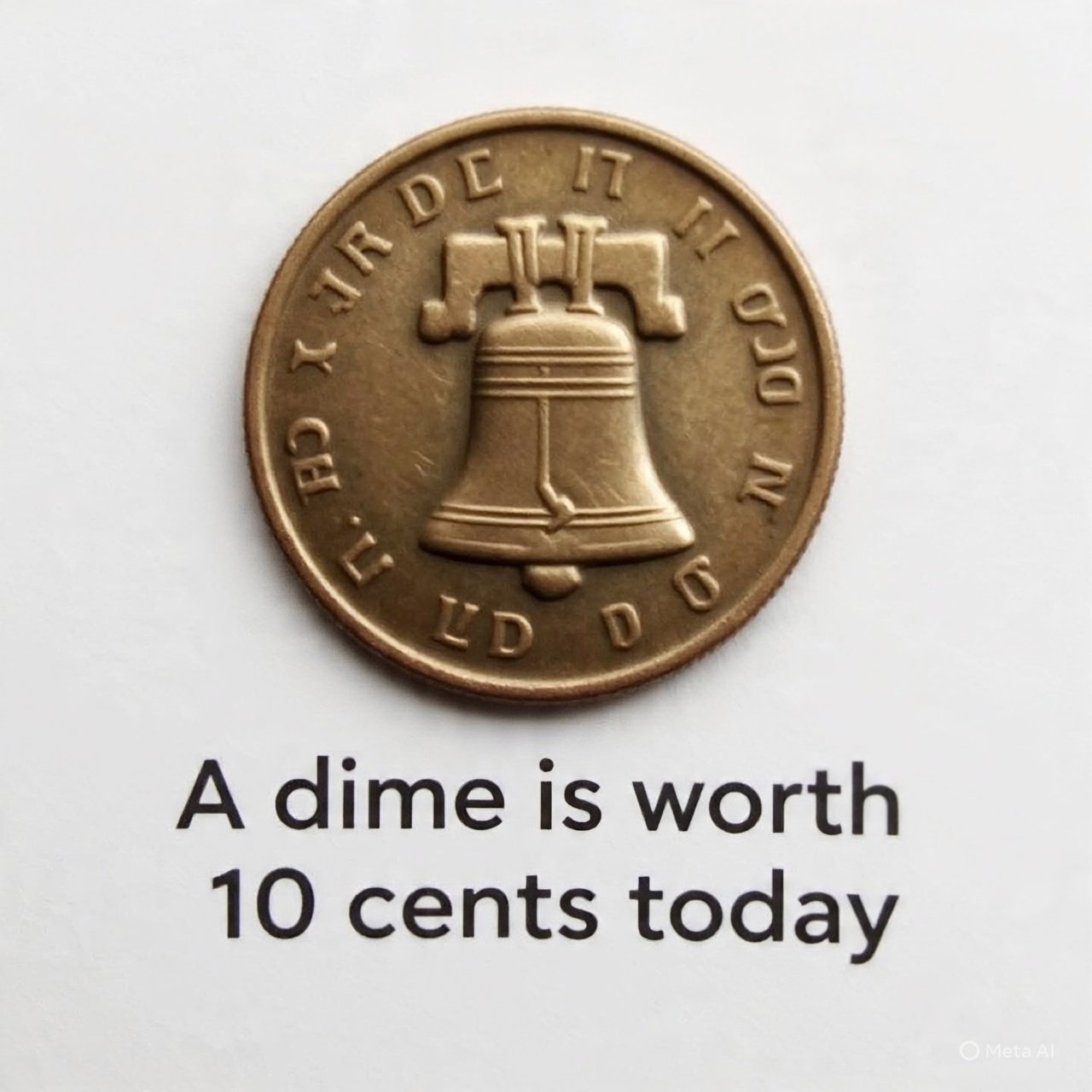
At first glance, the question how much is a dime sounds almost too simple to ask. Most people learn the answer in childhood, usually while counting coins on a kitchen table or at school. Yet millions of people still search for it every year. Some want a quick refresher, others are curious about old coins they found, and some wonder whether a dime from decades ago might be worth more than ten cents today.
The truth is that the value of a dime depends on what kind of value you’re talking about. There’s the official face value, the everyday spending value, the historical value shaped by inflation, and even collector value that can push a dime far beyond its original worth. Once you start looking closer, that small coin tells a surprisingly big story.
How Much Is a Dime?
A dime is worth 10 cents, or $0.10. That is its face value, meaning the legal amount it represents as United States currency. No matter where you spend it in the U.S., a dime counts as ten cents.
When people ask how much is a dime worth today, this is usually the answer they’re looking for. In modern circulation, the current value of a dime is fixed. It is legal tender backed by the U.S. government, and businesses must accept it at its stated value.
In simple terms:
- Dime value in cents: 10¢
- Dime value in dollars: $0.10
- How much money is a dime: one-tenth of a dollar
That said, this is only the starting point. The real curiosity begins when people compare what a dime can buy, what it used to buy, and whether certain dimes are worth more because of their metal content or rarity.
Understanding the Dime in the U.S. Coin System
What Is a Dime, Exactly?
A dime is a ten-cent coin used in the United States. It’s part of the broader system of US currency coins, which includes the penny, nickel, quarter, half dollar, and dollar coins. Among these, the dime has one of the longest histories and remains one of the most commonly used.
The modern American dime features President Franklin D. Roosevelt on the front, which is why it’s often called the Roosevelt dime. This design has been in use since 1946 and reflects the coin’s role in everyday transactions rather than decoration or symbolism alone.
In terms of denomination, the dime sits between the nickel and the quarter:
- Penny: 1 cent
- Nickel: 5 cents
- Dime: 10 cents
- Quarter: 25 cents
Why Is the Dime Smaller Than a Nickel?
One of the most common points of confusion is size. Despite being worth more, the dime is physically smaller than the nickel. This often leads people, especially children, to assume it’s worth less.
The reason is historical. Early U.S. coins were designed based on the value of the metal inside them. Since silver was more valuable than nickel, the dime didn’t need to be as large. This tradition stuck, even after the metal composition changed.
This makes the dime one of the smallest US coins, even though it holds a higher value than the nickel.
Face Value vs. Real-World Value
The Face Value of a Dime
The face value of a dime is the amount stamped into its role as legal currency: ten cents. This value does not change based on inflation, age, or appearance, as long as the coin is still valid legal tender.
This is what banks recognize, what cash registers accept, and what the U.S. Mint guarantees. From a legal standpoint, every modern dime has the same worth.
What a Dime Is Worth in Everyday Life
Where things get interesting is when people ask what is a dime worth in practical terms. While it still counts as ten cents, its everyday coin worth has changed dramatically over time.
Today, spending a dime doesn’t go very far. You can’t buy much with it on its own, which leads many people to wonder whether small coins are still useful. Still, the dime remains important in pricing, change-making, and rounding systems.
Dime Value Over Time: Past vs. Present
How Much Was a Dime Worth in the Past?
When people ask how much was a dime worth in the past, they’re usually thinking about purchasing power. Decades ago, a dime could buy items that now cost several dollars.
For example:
- In the early 1900s, a dime could buy candy, a newspaper, or public transportation.
- In the 1950s, it might cover snacks, basic groceries, or small household items.
- Even in the 1960s and 1970s, ten cents still held noticeable buying power.
This shift highlights the reality of inflation and dime value. While the face value stayed the same, what that dime could buy slowly shrank.
Purchasing Power and Inflation
Inflation reduces the purchasing power of money over time. The purchasing power of a dime today is far lower than it was 50 or 100 years ago. That’s why older generations often remember a time when “a dime actually meant something.”
This contrast fuels many online discussions and searches, especially when people compare prices across generations.
What Is a Dime Made Of?
Modern Dime Composition
If you’ve ever wondered what is a dime made of, the answer depends on when it was minted. Modern dimes are composed of a copper core with an outer layer of nickel. This combination makes them durable, affordable to produce, and resistant to wear.
Key physical details include:
- Dime metal composition: copper and nickel
- Dime weight: approximately 2.268 grams
These details matter mostly for identification and educational purposes rather than everyday spending.
Silver Dimes and Pre-1965 Value
Older dimes are a different story. Any U.S. dime minted before 1965 contains 90% silver. This dramatically affects its value.
When people search how much is a silver dime worth or how much silver is in a dime, they’re usually referring to these older coins. The value of a pre-1965 dime depends on current silver prices rather than its face value alone.
This is why pre-1965 dime value is often higher than ten cents, even if the coin is worn or damaged.
When a Dime Becomes a Collector’s Item
Rare and Collectible Dimes
Not all dimes are created equal. Some have value far beyond everyday use because of rarity, age, or condition. This is where coin collecting and numismatics come into play.
Collectors look for:
- Rare dime value based on limited minting
- Collectible dimes in excellent condition
- Old dimes worth money due to historical significance
Errors, Mint Marks, and Special Editions
Certain features can significantly raise a dime’s worth:
- Dime coin errors (misprints or production flaws)
- Mint mark dime value differences
- Proof dime value from special mint sets
- Graded dime value confirmed by professional services
These factors explain why two dimes that look similar can have completely different market values.
Comparing a Dime to Other U.S. Coins
Dime vs. Nickel vs. Quarter
Comparisons help people better understand coin values:
- Dime vs nickel value: 10 cents vs 5 cents
- Dime vs quarter: 10 cents vs 25 cents
- Dime compared to penny: 10 cents vs 1 cent
Understanding these relationships makes it easier to grasp the US coin system as a whole.
How Many Dimes Make a Dollar?
One of the most common questions tied to this topic is simple math. Since a dime is worth ten cents, ten dimes make one dollar. This reinforces the dime’s role in everyday transactions and change-making.
Is a Dime Still Useful Today?
What Can You Buy with a Dime?
On its own, not much. Prices have risen to the point where what can you buy with a dime is mostly symbolic rather than practical. Still, dimes play a role in:
- Exact pricing
- Cash transactions
- Vending and transit systems
Why the Dime Still Matters
Even if it doesn’t buy much alone, the dime remains an essential unit of currency value. It helps keep pricing flexible and ensures the U.S. monetary system functions smoothly.
Why Is a Dime Worth Ten Cents?
The meaning of a dime comes from its role as one-tenth of a dollar. The word itself traces back to the Latin decimus, meaning “tenth.” This design choice helped create a decimal-based currency system that is easy to calculate and use.
This simplicity is why the dime has survived countless economic changes and remains part of daily life.
Common Everyday Questions People Still Ask
How much is in a nickel?
A nickel is worth five cents, which is half the value of a dime.
Is 10 dimes a $1?
Yes. Since each dime is worth ten cents, ten dimes equal one dollar.
Is a dime 5 cents?
No. A dime is worth ten cents. Five cents is the value of a nickel.
What is 25 cents called?
Twenty-five cents is called a quarter, one of the most commonly used U.S. coins.
The Role of the Dime in Learning Money and Math
For many people, the United States dime is one of the first coins they learn to recognize. Because it represents a clean fraction of a dollar, it’s often used to teach basic math skills like counting, decimals, and simple conversions.
Teachers and parents commonly use dimes to explain:
- How decimals work in real life
- Why ten cents equals one-tenth of a dollar
- How multiple coins add up to larger amounts
Understanding how much is one dime helps learners move naturally from coins to paper money. That’s why the dime often appears in early financial education materials and games focused on money skills.
Converting Dimes to Dollars (and Why It’s So Common)
Another reason the dime shows up so frequently in searches is conversion. People regularly ask questions like how much is a dime in dollars or how much is a dime now when doing quick calculations.
Because the dime equals exactly ten cents, conversions are straightforward:
- 1 dime = $0.10
- 5 dimes = $0.50
- 10 dimes = $1.00
This simplicity makes the dime especially useful in mental math. It’s also why conversion tools and calculators often use dimes as examples when explaining how U.S. currency works.
The Dime’s Place Among U.S. Coins Explained Simply
When people search for US coins explained, they’re often overwhelmed by unnecessary details. In reality, the dime’s role is easy to understand when you see the system as a whole.
Each coin has a specific purpose:
- The penny handles single cents
- The nickel groups five cents
- The dime creates clean tens
- The quarter simplifies larger jumps
This structure keeps transactions efficient. Even as digital payments grow, physical coins like the dime still help anchor the value of the dollar in tangible terms.
Why People Still Ask About Old Dimes
Searches like old dime value or how much is a dime from 1964 worth are especially common among people who inherit coins or stumble across them in drawers, jars, or collections.
The year matters because:
- Dimes minted before 1965 contain silver
- Dimes minted after 1965 do not
A 1964 dime, for example, may look similar to a modern one but carries a higher intrinsic value due to its silver content. That distinction alone drives much of the ongoing curiosity around dime values.
Silver Content and Precious Metals Interest
Even people who are not serious collectors often take interest in precious metals. Silver prices fluctuate, and when they rise, so does interest in silver coins.
That’s why phrases like silver dime value and how much is a silver dime worth appear so frequently. The value of these coins depends less on their denomination and more on:
- Current silver prices
- The coin’s condition
- Market demand
This connection to metals gives the dime a second life beyond everyday spending.
Legal Tender and Why It Still Matters
The dime’s status as legal tender is another important aspect. No matter how small its buying power feels, it remains officially recognized currency. That means:
- It must be accepted for debts
- It retains its face value indefinitely
- It cannot simply become “worthless”
This legal foundation is part of what gives people confidence in the broader currency system. Even the smallest coins have guaranteed value, which reinforces trust in money as a whole.
Cultural References and the Dime’s Symbolic Meaning
Over time, the dime has also taken on cultural meaning. Phrases like “a dime a dozen” or references in music and storytelling reflect its role as a symbol of small but meaningful value.
In some contexts, the meaning of a dime goes beyond money. It can represent thrift, precision, or even nostalgia for a time when small amounts stretched further.
These cultural layers help explain why the dime remains relevant in conversation, even as its spending power declines.
Is the Dime Becoming Obsolete?
From time to time, debates arise about whether small coins should be phased out. While the penny often takes center stage in these discussions, the dime is rarely targeted.
That’s because:
- It still plays a functional role in pricing
- It fits neatly into decimal calculations
- It balances convenience and cost
As a result, the dime continues to hold its place in the US coin value hierarchy, even as payment habits evolve.
Why the Question “How Much Is a Dime?” Keeps Appearing
When you step back, it becomes clear why this simple question continues to appear in search engines year after year. It’s not just about ten cents. It’s about:
- Understanding money clearly
- Comparing past and present value
- Identifying collectible coins
- Teaching financial basics
Whether someone is a student, a parent, a collector, or just curious, the dime provides an easy entry point into broader financial understanding.
